Upper Mustang Tiji Festival Tour
The Tiji Festival is one of the most significant Buddhist festivals celebrated in Upper Mustang, held annually in Lo Manthang over three days. The festival features traditional masked dances, prayers, music, and religious rituals performed by monks, based on the story of Dorje Jono and his battle against destructive forces. For visitors, it offers an opportunity to experience Mustang's living Buddhist culture at a time when the local community comes together for an important religious celebration.
The festival takes place in Lo Manthang, a historic walled settlement at around 3,800 meters (12,467 feet) in the remote Upper Mustang region. Reaching the festival is part of the experience. The journey passes through one of Nepal's most distinctive high-altitude landscapes, with dry river valleys, red and brown cliffs, ancient caves, monasteries, chortens, prayer walls, and traditional Mustang villages. The landscape and architecture reflect the region's long cultural and historical connection with the Tibetan plateau.
What makes a Tiji Festival Tour different from a standard Upper Mustang trek is the timing. Instead of visiting Lo Manthang only as a historic Himalayan settlement, you arrive when its religious and community life is at its most active. The three festival days provide a closer look at Buddhist traditions that continue to play an important role in the cultural identity of Mustang.
The journey also involves high-altitude travel, restricted-area permits, long overland sections, and limited accommodation infrastructure, so planning is important. Understanding the festival dates, route, altitude, transportation, permits, accommodation, weather, and expected costs can make a significant difference to the overall experience.
This guide covers the Tiji Festival in practical detail, including its history and religious significance, the rituals performed during each of the three days, how to reach Lo Manthang, the best time to travel, permits and costs, itinerary options, altitude and difficulty, accommodation, packing requirements, and important considerations for experiencing the festival respectfully.
What Is the Tiji Festival?
The Tiji Festival, also known as Tenchi, is a three-day Buddhist ritual celebrated annually in Lo Manthang, Upper Mustang. The name is commonly linked to Tenpa Chirim, understood as a prayer or aspiration for the benefit of Buddha's teachings and all sentient beings. The festival is rooted in the Vajrakila (Dorje Phurba) tradition of Vajrayana Buddhism and centers on the story of Dorje Jono, a protector figure who defeats destructive forces threatening the people and land of Mustang.

The tradition has a much longer history than the modern tourist interest in Upper Mustang. The Nepal Tourism Board traces the festival's beginnings in Mustang to the early 15th century, when Khenchen Sonam Lhundrup introduced the practice, while its major revival is associated with King Samdup Rabten and Sakya master Ngawang Kunga Sonam in the 17th century. The tradition was restored again in 1963 after a period of disruption. This history is important because it shows that Tiji is not a festival created for tourism; it is a religious practice that has been maintained, revived, and passed between generations in Lo Manthang.
The Story of Dorje Jono
At the center of Tiji is the story of Dorje Jono, associated with Vajrakila, a powerful protective figure in Vajrayana Buddhism. In the Mustang tradition, destructive forces bring hardship to the kingdom, including drought, suffering, and disorder. Dorje Jono confronts these forces and ultimately defeats them, restoring peace and protection to the land. The story has particular meaning in Upper Mustang because the region is one of the driest parts of Nepal.
Water has always been essential to agriculture and settlement in this high-altitude landscape, so the symbolic defeat of a force associated with drought and destruction represents a much deeper wish for protection, prosperity, peace, and the continued well-being of the community.
The three days of Tiji present this religious story through masked dances and ritual performances by monks. Rather than watching a theatrical show created for visitors, the community is observing a religious ceremony in which the dances themselves have ritual meaning.
What Happens During the Three Days?
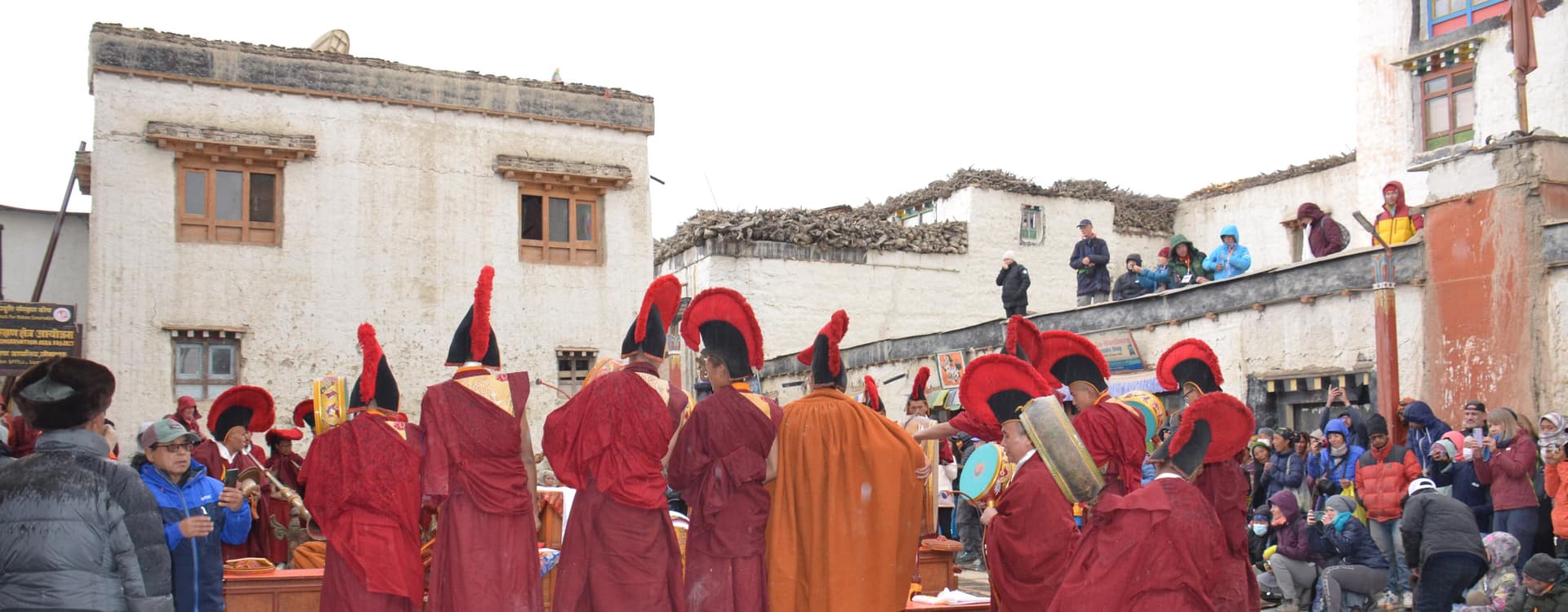
The festival takes place in and around the historic center of Lo Manthang, with monks carrying out carefully prepared rituals, prayers, chanting, music, and masked dances. The performers wear elaborate ceremonial costumes and masks representing different Buddhist figures and symbolic forces.
The movements are highly structured; according to the Nepal Tourism Board, some monks prepare through three months of retreat before participating in the sacred dances.
Each day has a different ritual purpose, gradually developing the story of the struggle against negative forces and bringing it toward its conclusion. On the final day, ritual offerings are used to symbolically remove negativity, completing the festival's prayer for peace and harmony.
For visitors, this means the experience is much more than seeing monks in colorful masks. You can expect to encounter religious chanting, traditional instruments, prayers, masked dances, ceremonial costumes, ritual objects, and large community gatherings around the festival area. Local residents from Lo Manthang and surrounding settlements participate alongside the monks, making Tiji an important social occasion as well as a religious one.
Why Is Tiji Festival Important?
Tiji matters because it brings together several parts of Upper Mustang's identity that are rarely experienced together in such a concentrated way. Religiously, it is a Vajrayana Buddhist ritual centered on protection, the removal of negative forces, and prayers for peace and prosperity. Culturally, it preserves dances, stories, costumes, music, rituals, and religious knowledge associated with Mustang's Tibetan Buddhist heritage. The festival also reflects the region's historical connection with the wider Tibetan Buddhist cultural world while remaining firmly rooted in the local community of Lo Manthang.

For travelers, perhaps the most valuable aspect is that Tiji remains a living tradition. You are not simply visiting an old monastery or looking at historical objects; you are seeing local monks perform rituals that have religious meaning for the people who live there. That distinction is worth keeping in mind when attending the festival: Tiji is a religious ceremony first and a tourism experience second. Understanding that makes the three days in Lo Manthang considerably more meaningful.
When Is the Tiji Festival Celebrated?
The Tiji Festival is celebrated once a year in Lo Manthang, Upper Mustang, over three consecutive days. Unlike festivals that follow a fixed Gregorian date, Tiji follows the Tibetan lunar calendar, so its date changes from year to year when converted to the international calendar. The Nepal Tourism Board notes that the festival is traditionally held during the third month of the Tibetan calendar, which is why it generally falls around the spring or early summer period in Nepal.
For travelers, this changing date is an important planning detail. For example, the festival was held from May 14 to 16, 2026, while the next celebration is scheduled for June 1 to 3, 2027, in Lo Manthang. The shift of several weeks from one year to another shows why travelers should never rely on a date from an older Tiji Festival article when planning their trip.
Tiji Festival Dates 2027
Festival Day | Date | Location |
Day 1 | June 1, 2027 | Lo Manthang, Upper Mustang |
Day 2 | June 2, 2027 | Lo Manthang, Upper Mustang |
Day 3 | June 3, 2027 | Lo Manthang, Upper Mustang |
The three-day celebration in 2027 runs from Tuesday, June 1, through Thursday, June 3. Current festival itineraries identify these as the first, second, and final days of the main Tiji celebration.
Why Should You Plan Early for Tiji Festival?
Planning early matters more for Tiji than for an ordinary Upper Mustang trip because everyone who wants to experience the complete festival needs to be in Lo Manthang on the correct three days. Reaching the town is itself a journey through a remote Himalayan region, so arriving at the last minute leaves little room for transportation delays, changing road conditions, or altitude-related adjustments.
Accommodation is another consideration. Lo Manthang is a small high-altitude settlement, and demand for rooms increases when visitors arrive for the festival. Transportation and trekking arrangements also become busier around the event. Some tour operators recommend booking several months ahead, particularly for festival-season accommodation, permits, guides, and transportation.
For this reason, it is better to reach Lo Manthang at least a day or two before the first festival ceremony, rather than planning your journey to arrive on June 1 itself. This gives you time to settle in, adjust to the altitude, and explore the town before the ceremonies begin. It also provides a practical buffer if your journey through Mustang takes longer than expected.
If you are planning the 2027 Tiji Festival Tour, the key dates to remember are June 1 to 3, 2027. However, for future years, always check the dates again because the Tibetan lunar calendar means the Gregorian dates will continue to change.
Where Is the Tiji Festival Held?
The Tiji Festival is held in Lo Manthang, the historic capital of the former Kingdom of Lo and the cultural center of Upper Mustang. The town lies in northern Mustang, close to the Nepal–Tibet border, on a high plateau of the upper Kali Gandaki region. Lo Manthang was established as the capital of the Kingdom of Lo in the late 14th century, and its historic settlement was built at approximately 3,800 meters (12,467 feet) above sea level.
Lo Manthang is not simply the location chosen for the festival; its history explains why Tiji is celebrated here. The town developed as an important political, trading, and religious center along the ancient trans-Himalayan route connecting the Tibetan plateau with the areas farther south. Its residents, traditionally known as Loba, have strong cultural connections with Tibet, while Sakya Tibetan Buddhism has played a central role in the town's religious life for centuries. Within the old walled settlement are historic monasteries, temples, chortens, prayer walls, and traditional earthen buildings.
Upper Mustang Tiji Festival Tour Itinerary
This 14-day Upper Mustang Tiji Festival Tour combines the remote landscapes of Mustang with the three-day Tiji Festival in Lo Manthang. The journey begins in Kathmandu and gradually moves from the more developed cities of Nepal into the dry, high-altitude valleys of Mustang. Along the way, travelers pass through Jomsom, Ghami, Lo Manthang, Chhoser, Charang, Dhakmar, Muktinath, Kagbeni, and Marpha before returning to Kathmandu.
The itinerary is designed to allow travelers to reach Lo Manthang before the festival begins, spend two days exploring its surrounding cultural sites, and then dedicate three full days to the Tiji celebrations. Because much of the Upper Mustang journey is completed by private jeep, this itinerary is particularly suitable for travelers who want to experience the festival and region without committing to a long walking-based trek.
Day 1: Kathmandu arrival, then transfer to hotel.
Day 2: Kathmandu to Pokhara by tourist bus (3-star hotel)
Day 3: Drive to Jomsom by private jeep (Stay in Tea House)
Day 4: Drive to Ghami (stay in Tea House).
Day 5: Drive to Lo-Manthang; evening visit the village
Day 6: Chhoser Cave and drive tibeten border visit.
Day 7: Tiji festival (first day)
Day 8: Tiji festival (second day)
Day 9: Tiji festival (final Day)
Day 10: drive to Dhakmar via charang and some beautiful ares.
Day 11: Drive to Marpha via Muktinath and Kagbeni
Day 12: Drive to Pokhara
Day 13: Drive back to Kathmandu
Day 14: Fly back home
Upper Mustang Tiji Festival Tour Cost
The cost of an Upper Mustang Tiji Festival Tour depends on several factors, so there is no single price that applies to every traveler. A 14-day tour will generally cost more than a shorter itinerary because it includes more accommodation, transportation, meals, and other travel expenses. The remote location of Upper Mustang and the increased demand during the Tiji Festival also make this trip more expensive than many standard Nepal tours.
Factors Affecting the Price
Number of Days: More days mean higher costs for accommodation, meals, and transportation.
Transportation: Private jeep travel through Upper Mustang can be a major part of the budget. Domestic flights, if included, add to the cost.
Accommodation: Hotels in Kathmandu and Pokhara are generally more developed, while Upper Mustang mainly has basic tea houses and lodges. Festival-season rooms in Lo Manthang may cost more due to demand.
Permits: The Upper Mustang Restricted Area Permit and Annapurna Conservation Area Permit (ACAP) are required costs for the journey.
Meals: Food costs vary depending on what the package includes and increase in remote areas.
Group Size: Sharing a private jeep among several travelers can significantly reduce the per-person cost.
Festival Season: Accommodation and transportation can become more expensive or limited during the Tiji Festival, making early booking important.
When comparing tour prices, check what is actually included rather than choosing the cheapest advertised package. Permits, private transportation, accommodation, meals and festival-season arrangements can make a substantial difference in the final cost.
Photography During the Tiji Festival
The Tiji Festival offers some of the most distinctive photography opportunities in Upper Mustang because the experience combines religious ceremonies with the dramatic landscape and traditional architecture of Lo Manthang. The contrast between the colorful masks and ceremonial costumes of the monks and the dry, earth-toned Himalayan surroundings creates particularly striking images.
The three-day festival gives photographers plenty to capture, including masked dances, monks performing rituals, traditional musical instruments, prayers, and gatherings of local residents. Beyond the festival itself, the old streets of Lo Manthang, its monasteries, prayer walls, chortens, traditional mud-brick buildings, and surrounding cliffs provide a strong cultural and landscape backdrop. The journey through Upper Mustang also offers opportunities to photograph dry river valleys, red and brown rock formations, remote villages, caves, and snow-covered Himalayan peaks.
A good approach is to spend some time observing before taking photographs. This allows you to understand what is happening and often results in better images while ensuring that the people participating in this important tradition remain the priority.